
Why this lesson matters
Once you've got attributes, resistances, and Spirit under control (see Primary attributes, defenses, Spirit, and controls), the passive tree is where you actually shape your build. POE2's tree has a few mechanics that don't exist in most other action-RPGs — get them wrong and you'll either lock yourself out of gear you need, or waste Gold undoing allocations you didn't mean to make.
One shared tree, different starting points
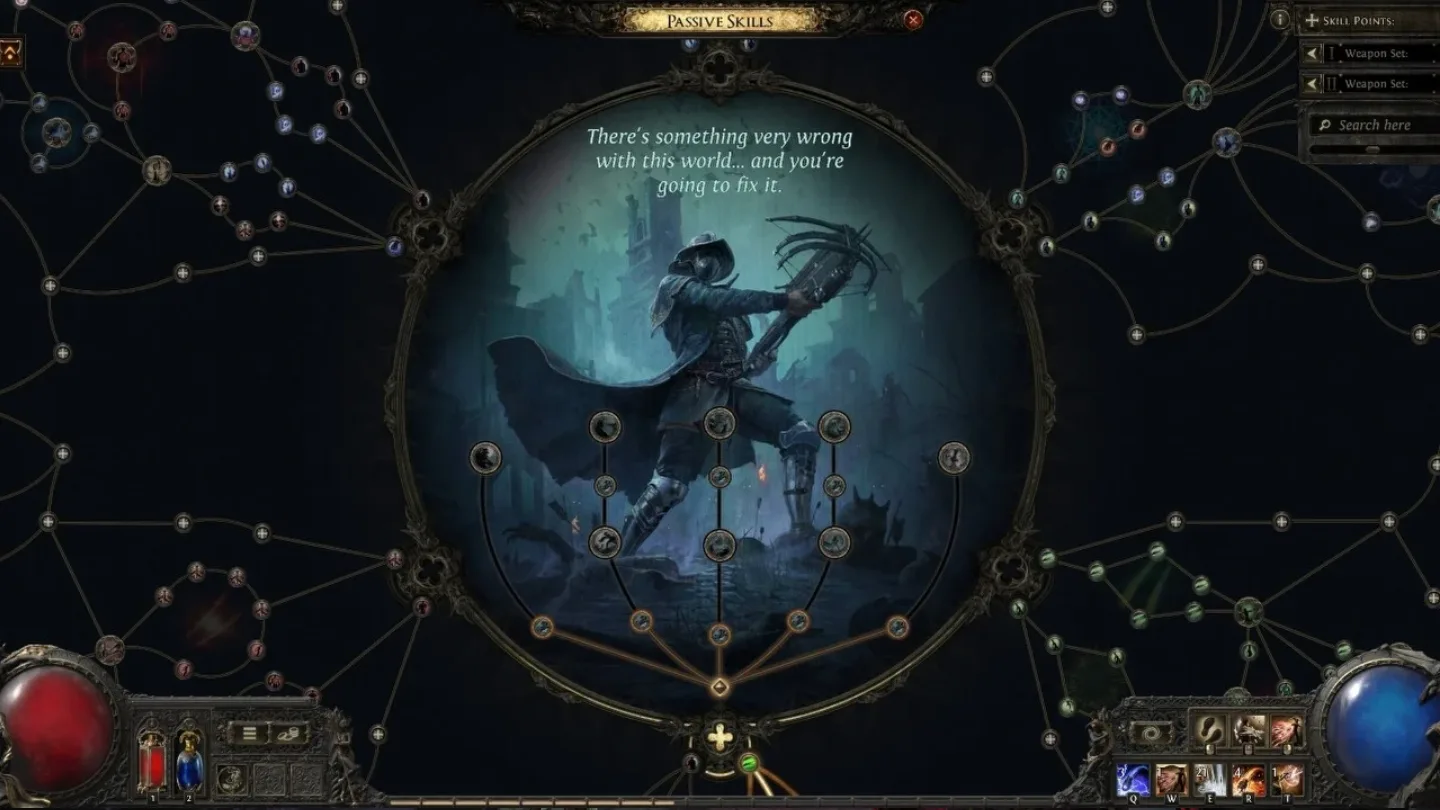
Every class uses the same passive tree. There's no class-exclusive tree — what differs is where on the tree each class and Ascendancy starts, which pulls you naturally toward the nodes that suit that class without walling you off from anything else. A Warrior and a Sorceress are drawing from the same map; they just start in different neighborhoods.
Flexible attribute travel nodes
Small travel nodes — the basic connector nodes you path through to reach everything else — let you choose which attribute they grant at the moment you allocate them: +5 Strength, Dexterity, or Intelligence, your pick. This is different from older-style trees where a travel node's attribute is fixed by its position.
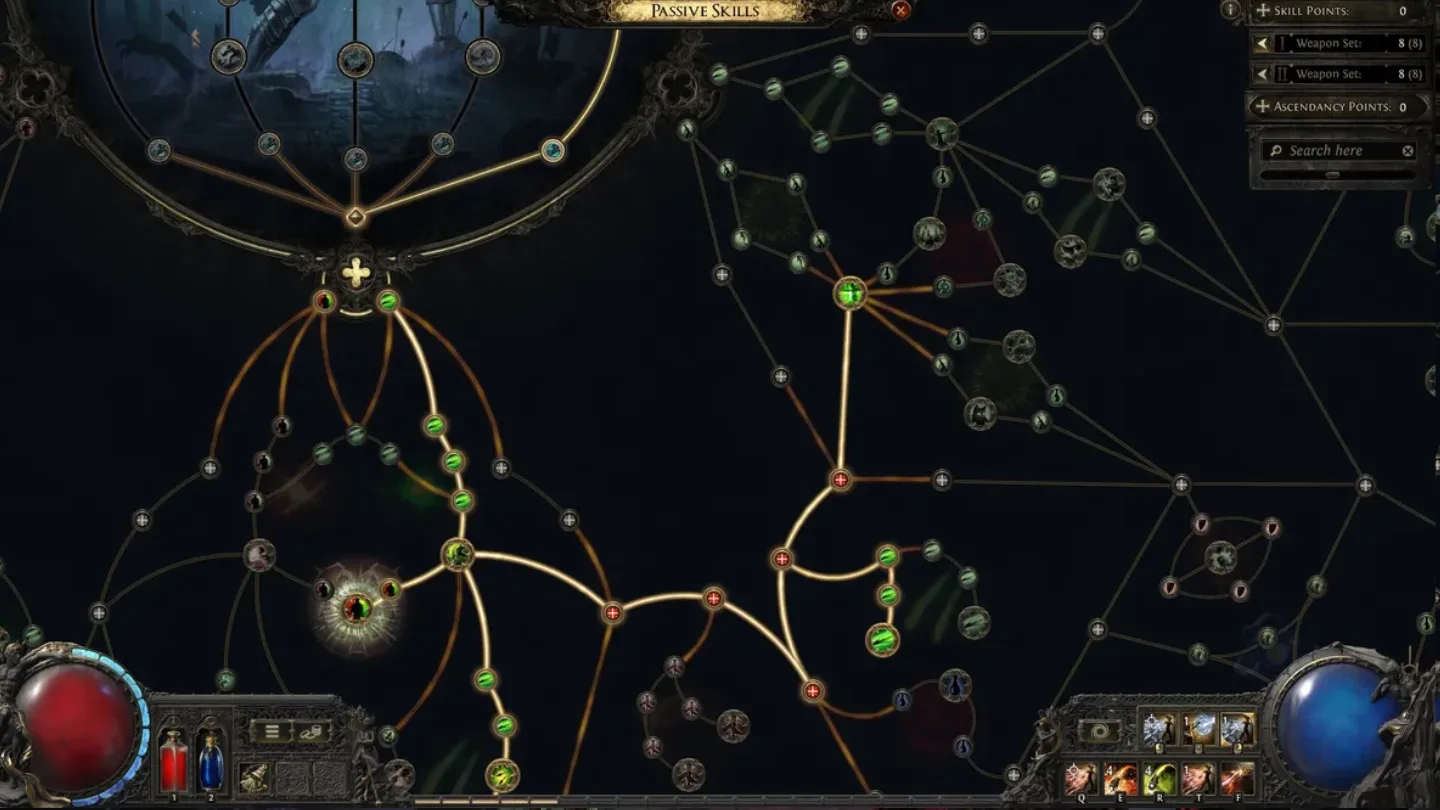
Practically, this means you're not locked out of a build just because the shortest path to a notable happens to run through "the wrong" attributes. If you're a Dexterity-based character pathing near the Intelligence side of the tree, take Dexterity on those travel nodes anyway and keep your gear requirements met.
One more detail worth knowing: refunding an attribute travel node costs 50% less Gold than refunding other node types, so re-tuning your attribute choices as your gear changes is cheap relative to reworking the rest of your tree.
Dual specialization and Weapon Set Points
This is the tree mechanic most likely to get described wrong, so it's worth being precise about it.
It is not a second, separate tree. You have one shared passive tree, period. What POE2 adds on top is Weapon Set Points — a limited pool of points, separate from your normal passive skill points, that you earn through campaign progression (mainly from quest-reward "Quest Books"). When you have an unallocated point from that pool, you can spend it to tag a specific node on your one tree so that node is only active while a particular weapon set — Set 1 or Set 2 — is equipped. Swap weapons in combat, and any tagged nodes for the set you just left switch off while the tagged nodes for the set you just equipped switch on, automatically.
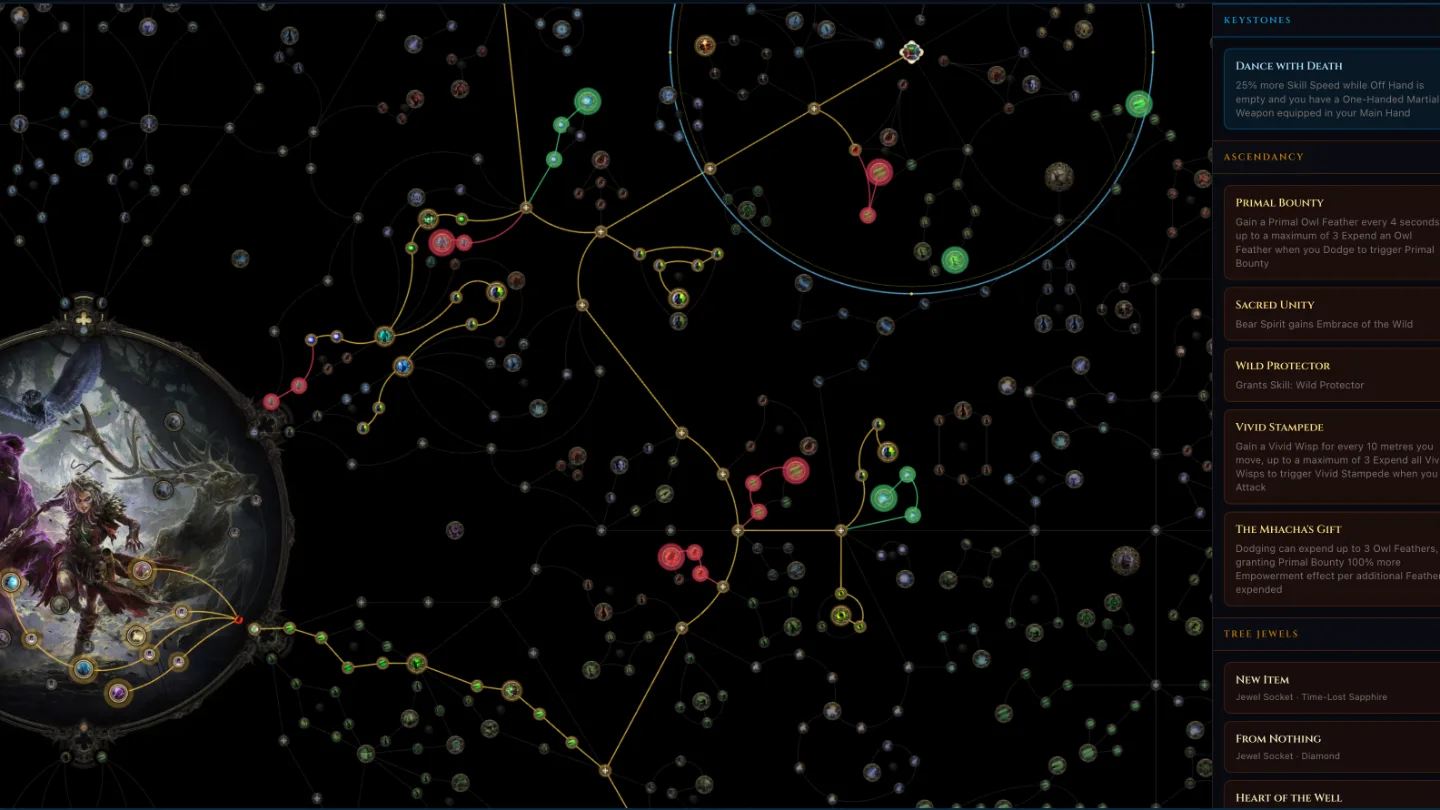
In practice this lets you lean a staff-and-spells setup toward Area of Effect and elemental scaling, and a dagger-and-attacks setup toward single-target and attack speed, using two weapon sets on the same character — without needing two full trees or two characters. The number of Weapon Set Points available scales with campaign progression; Maxroll's own reference materials show it reaching into the twenties by the time you've cleared the relevant quest content, though exactly how many you'll have at a given point depends on which quests you've completed.
Keystones
Keystones are the large, build-defining nodes near the edges of the tree. Unlike a Notable — which gives you a strong bonus with no real downside — a Keystone changes a core rule of how your character works, and it comes with an explicit trade-off baked in.
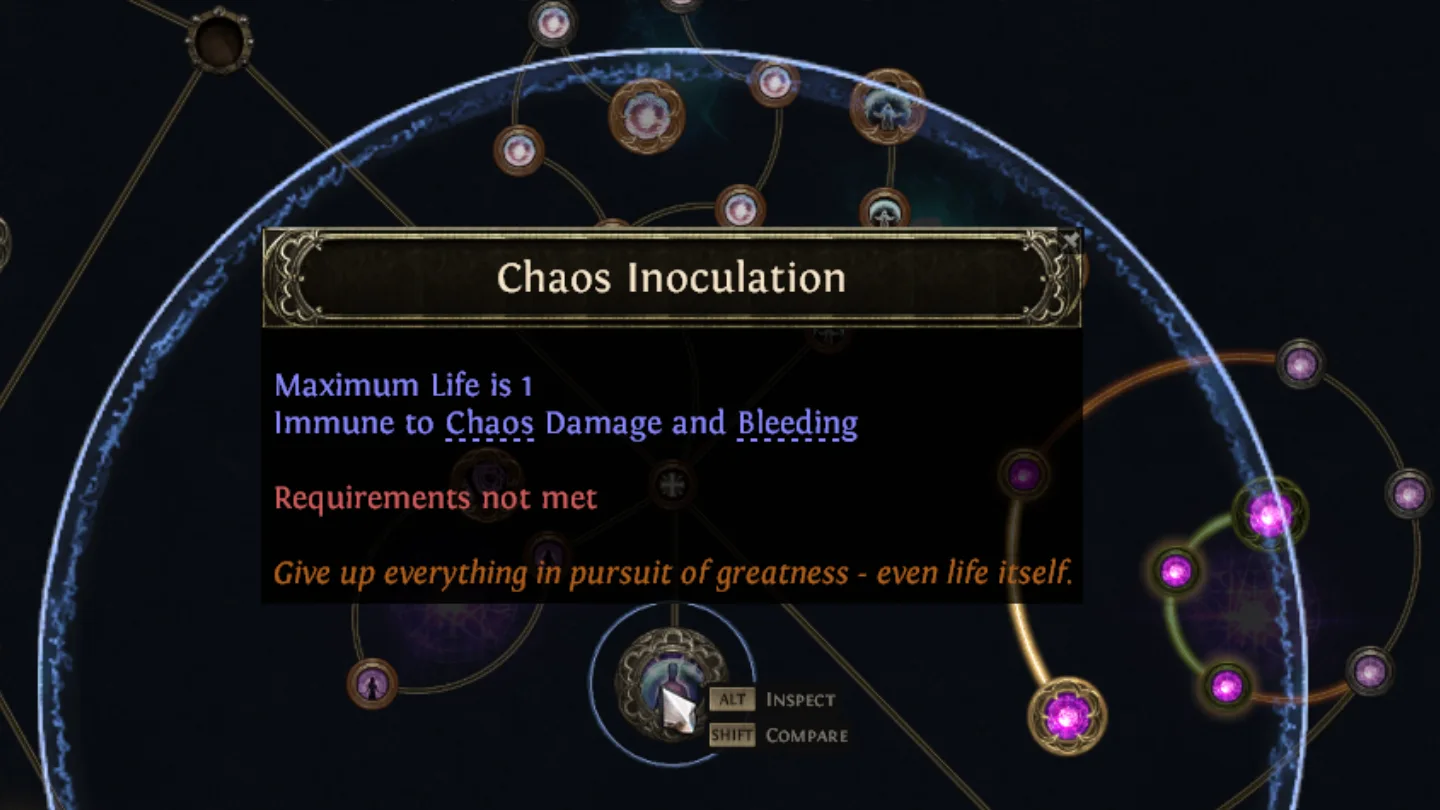
The clearest example: Chaos Inoculation sets your Maximum Life to 1, in exchange for immunity to Chaos damage (and Bleeding, per the node text). That's not a minor stat swap — it's a different way of building your entire defense around Energy Shield instead of Life, since 1 Life means literally any non-Chaos hit that gets through your Energy Shield kills you. Keystones like this are the reason "read the whole node" matters more on this tier than any other.
Node tiers, at a glance
| Tier | What it does |
|---|---|
| Attribute Travel | Small connector nodes; +5 to a chosen attribute (Str/Dex/Int) |
| Minor / Small Passive | Small stat bonuses — damage, life, defenses, utility |
| Notable Passive | A meaningfully larger, more specialized bonus, visually distinct from Minor nodes |
| Keystone | Build-defining mechanic change, always with an explicit trade-off |
(The exact visual styling — colors, borders — varies by how you're viewing the tree and isn't worth memorizing; the tiers themselves and their relative size on the tree map are the reliable way to tell them apart at a glance.)
Respeccing
If you misallocate a node, or want to re-path toward a Keystone you didn't originally build for, you don't need to reroll the character. Respec through The Hooded One, an NPC at Clearfell Encampment, unlocked by completing the Act 1 quest "The Mysterious Shade" (roughly levels 10–15). Respeccing costs Gold, not Orbs of Regret — POE2 doesn't use POE1's Orb of Regret system at all.
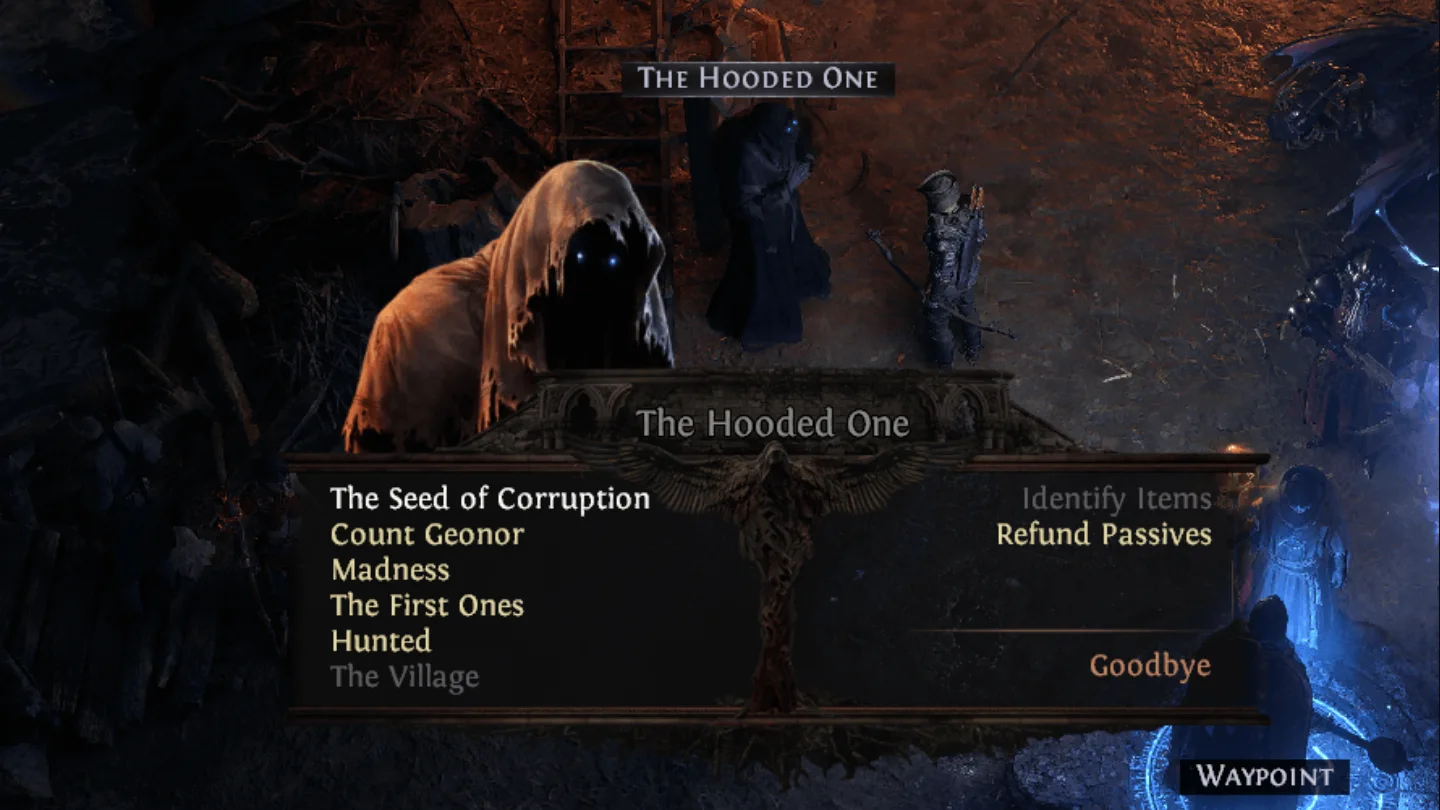
The Gold cost of refunding a given node scales with how deep that node sits in the tree — a node you allocated dozens of points ago, out toward a Keystone, costs more to refund than one just off your starting point. It is not simply "each respec you do costs more than the last" in a flat compounding sense; it's the specific node's position that drives the cost. Attribute travel nodes are the exception, at a flat 50% discount regardless of depth (see above).
Practical upshot: batch your respecs when you're reworking a section of the tree rather than refunding node-by-node as you go, since planning the change first avoids paying the "deep node" cost twice for the same stretch of path.
Practical tips
- Use attribute travel nodes to solve gear-requirement problems on the fly instead of holding off on an upgrade.
- Plan your Weapon Set Point tags around a real two-weapon build (e.g., AoE caster set + single-target attack set) rather than spreading them thin — the pool is limited.
- Read a Keystone's full trade-off before allocating it. "Extreme power, explicit cost" is the pattern — the cost is never cosmetic.
- If you're not sure a respec is worth it, check how deep the node you want to refund actually is — the deeper it is, the more it'll cost to undo.
Sources: Maxroll — Passive Tree & Dual Specialization · Maxroll — Weapon Swap Mechanics · Mobalytics — Passive Skill Tree · Mobalytics — Dual Specialisation · Game8 — Chaos Inoculation · TheGamer — How to Respec · GamesRadar — Respec Guide · PC Gamer — Respec Gold Costs