
Why this lesson matters
Survival & resistances: why you die covered your passive defense stack — resistances, Energy Shield, how ailments work. This one covers the tools you actually use mid-fight to not die: Flasks and Charms. If you're coming from Path of Exile 1, or another game with a big potion/flask economy, the mental model you're bringing in is probably wrong for POE2 — the whole system got smaller and more automated.
Life Flasks heal over time, not instantly
This is the single most important thing to get right. A Life Flask recovers a fixed amount of Life over roughly 3-5 seconds, not all at once. Recovery stops automatically once you're topped off, so there's no waste — but the flip side matters more: popping a flask at 10% HP doesn't save you the way an instant potion would. If incoming damage during that few-second recovery window outpaces the trickle heal, you can still die mid-flask. The fix isn't a better flask — it's using it earlier, against sustained damage, before you're in real danger, rather than as a last-second panic button.
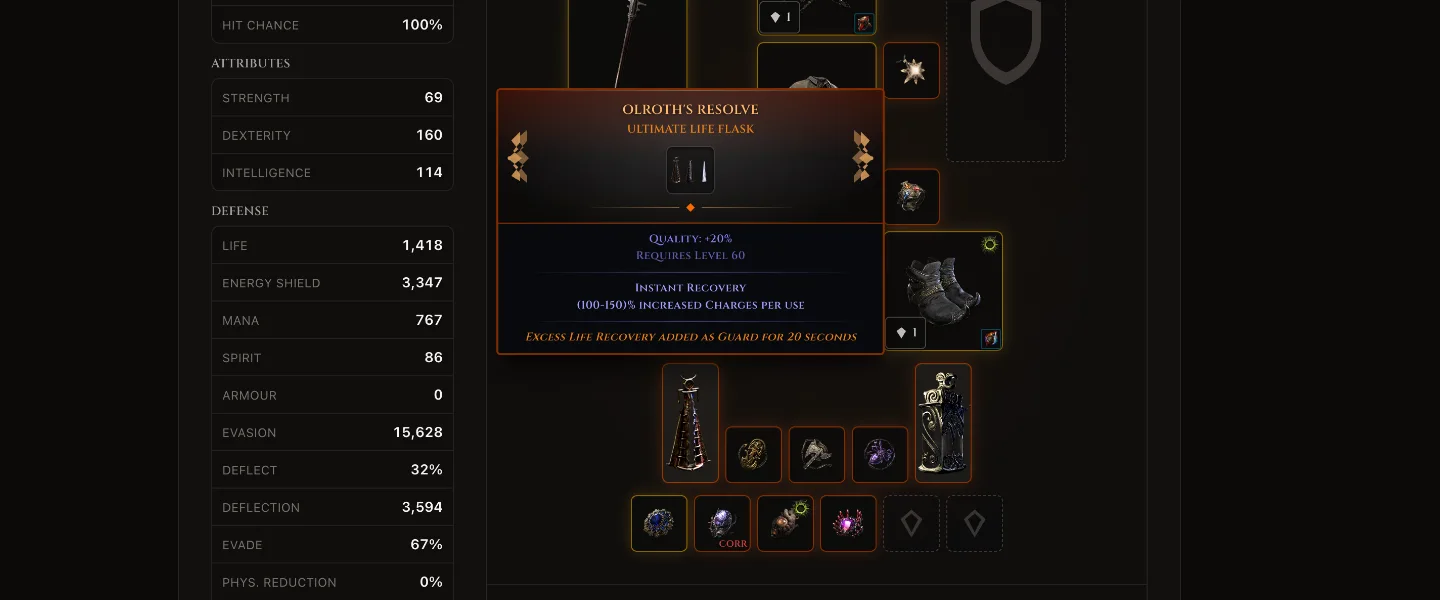
A few items break the default trickle, and they're exceptions, not the rule: some unique Life flasks (Olroth's Resolve is the one in the screenshot below) have Instant Recovery, and the Utility Belt base applies 20% of flask recovery instantly. Don't read those as "flasks are instant now" — a normal Life Flask is still a few-second heal.
Mana Flasks are still a thing — Spirit didn't replace them
Worth clearing up a common mix-up: Spirit didn't replace Mana. It replaced Mana reservation — the old system where auras and persistent buffs permanently locked away part of your Mana pool. Mana itself is still your normal active-skill-cost resource, and a standard Mana Flask still recovers it, working exactly like a Life Flask (over time, stops at full).
No utility flasks — that whole category is gone
If you've played Path of Exile 1, you're expecting Quicksilver Flasks for movement speed, Granite Flasks for armor, Jade for evasion, Sulphur for damage — a whole tier of situational utility flasks that were often build-defining. None of that exists in POE2. There are exactly two flask types: Life and Mana. Some unique flasks add bonus effects on top of their core recovery, but they're still fundamentally Life or Mana flasks, not a separate slot. You get 2 flask slots total, fixed — one Life, one Mana — not something you unlock or expand.
The old utility-flask job — anti-ailment protection, situational resistance boosts — didn't disappear. It moved to a different system entirely: Charms.
Charms auto-trigger — you don't press a button for them
This is the core distinction: a flask requires you to manually activate it; a charm fires itself the instant its trigger condition is met. Equip a Staunching Charm, and the moment you start Bleeding, it activates on its own — no input needed. Three categories exist:
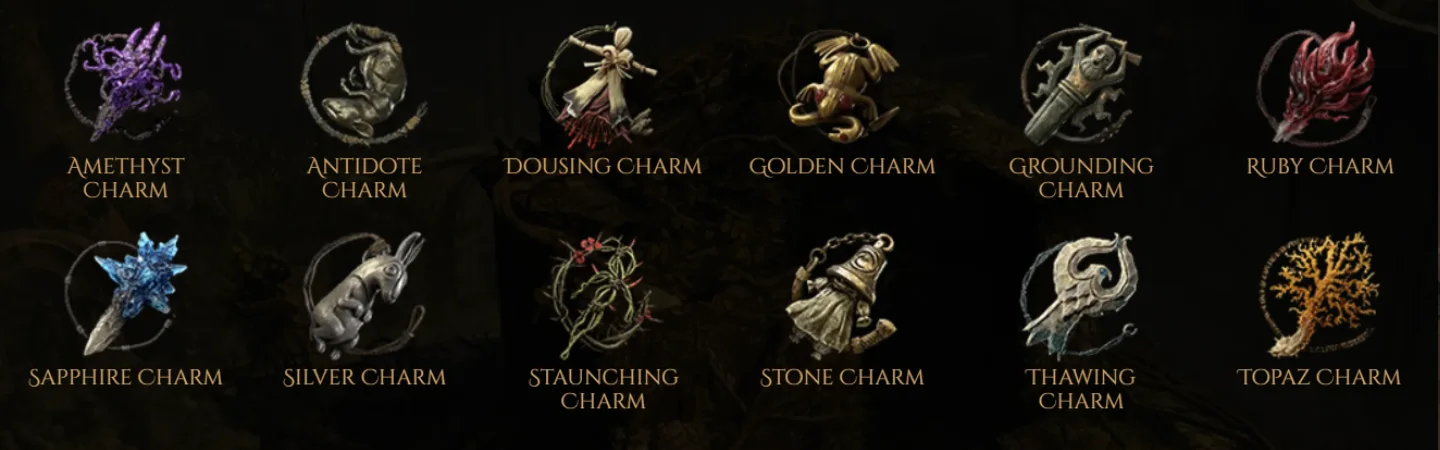
- Resistance charms (Ruby, Sapphire, Topaz, Amethyst) — auto-boost the matching resistance when you take that damage type.
- Ailment-immunity charms (Staunching, Thawing, Antidote, Dousing, Grounding, Stone) — auto-grant temporary full immunity to Bleed, Freeze, Poison, Ignite, Shock, or Stun respectively, the instant that ailment would land.
- Utility charms — situational effects like the Golden Charm's bonus rarity from rare/unique kills, or the Silver Charm firing when you get Slowed.
The exact auto-trigger for each common base:
| Charm | Fires when |
|---|---|
| Staunching Charm | you start Bleeding |
| Thawing Charm | you become Frozen |
| Antidote Charm | you become Poisoned |
| Dousing Charm | you become Ignited |
| Grounding Charm | you become Shocked |
| Stone Charm | you become Stunned |
| Silver Charm | you are affected by a Slow |
| Ruby Charm | you take Fire damage from a Hit |
| Sapphire Charm | you take Cold damage from a Hit |
| Topaz Charm | you take Lightning damage from a Hit |
| Amethyst Charm | you take Chaos damage from a Hit |
| Golden Charm | you kill a Rare or Unique enemy |
Unique charms keep that same trigger and layer an extra effect on top — Rite of Passage is still a Golden Charm that fires on a rare/unique kill, then possesses you with a spirit.
Charm slots come from your belt — plus one campaign quest
Unlike flasks, charm slots aren't a fixed default. They come from your equipped belt's implicit, capped at 3. Early-campaign belts typically carry just 1 slot; belts with more become available later. No belt with charm slots equipped means zero charm coverage, regardless of how many good charms you're carrying in your inventory.
One extra slot is a campaign reward, not a belt roll. Completing Ancient Vows in Act 2 (Valley of the Titans — insert the Kabala and Sun Clan Relics) grants +1 Charm Slot on *both* altar choices, plus either 30% increased Charm Charges gained or 30% increased Charm Effect Duration. You can swap that choice later at the same altar. Older walkthroughs that only list charm-charges vs mana-flask recovery, with no slot, are pre-0.3.0. The hard cap is still 3 — this quest fills a slot, it doesn't raise the ceiling.
A charm is not permanent immunity
Here's the trap: a Staunching Charm doesn't make you bleed-proof for the rest of the fight. It's a charge-limited consumable, same as a flask — it just triggers itself instead of needing a keypress. If you've already proc'd it once or twice against repeated bleed applications and haven't had a chance to refill, the *next* bleed lands with no protection, and you won't necessarily notice until it's already hurting you. Don't treat an equipped anti-ailment charm as a permanent flag you can stop thinking about.
Both systems refill the same way — kills, a Checkpoint, or a Well
Flasks and charms share their refill sources, but track separately (running one dry doesn't affect the other). Charges come from killing monsters, scaled to what you kill. Checkpoints (including the ones in maps) and Wells in town/hideout areas instantly top off everything at once. Neither system regenerates on its own over time. The practical consequence: a rough fight where you're taking damage without landing kills can leave you dry on both flasks and charms simultaneously, with no way to refill mid-fight except more kills — or reaching a Checkpoint.
The direct link back to Energy Shield
This connects straight to the resistances lesson: Bleed and Poison both bypass Energy Shield entirely and hit your Life directly. A big ES pool looks like strong protection on paper, but it does nothing against those two ailments specifically. This is exactly why Staunching and Antidote charms — or well-timed Life Flask use — matter even on a heavily ES-stacked build. More Energy Shield doesn't answer this problem; the right charm does.
One more small but concrete detail: Life Flasks recover Life only, not Energy Shield, by default. The single documented exception is a keystone passive called Eternal Youth, which redirects Life recovery to ES instead — a deliberate, niche build choice, not something that happens by accident.
Practical tips
- Flask early against sustained damage, not as a last-second save — the heal is a trickle over a few seconds, not an instant refill.
- Don't treat an ailment-immunity charm as permanent — it's charge-limited like a flask, and repeated procs without a refill will leave you exposed without warning.
- If your build leans on Energy Shield, get a Staunching and/or Antidote charm slotted — ES doesn't stop Bleed or Poison, and those are exactly the ailments a big ES pool can't help with.
- Prioritize not taking damage over reactive flask spam — kills refill both flasks and charms, so a fight with heavy incoming damage and few kills can drain both pools with no way to top off until a Checkpoint or Well.
- Get a belt with at least one charm slot early if you want any ailment coverage at all — no belt slot means no charm, no matter what you're carrying.
- Don't skip Ancient Vows in Act 2 — both altar picks include +1 Charm Slot, and you can swap the other half of the bonus later.
- Leave the Path of Exile 1 flask mental model behind — no utility flasks, no big flask bar, just 2 flask slots plus up to 3 charm slots (belt + that quest).
Sources: Mobalytics — Flasks Explained · Mobalytics — Charms Explained · Mobalytics — Energy Shield · Mobalytics — Ailments · Maxroll — Defence Guide · Maxroll — Spirit Guide · Maxroll — Permanent Stats From The Campaign (0.5.4) · PoE2 Wiki — List of life flasks · PoE2 Wiki — Ancient Vows · Game8 — How to Refill Flasks · Game8 — How to Increase Charm Slots · GameRant — Charm System, Explained · Fextralife — Charms